

featured
2026-09-21
9/21/2026
Agriculture
published

Understanding an Ag Operating Line of Credit: Smoothing Cash Flow Between Cattle and Poultry Cycles
Running a cattle or poultry operation means spending money long before the income tied to that expense arrives.
Feed has to be purchased, and veterinary care cannot always wait. Labor, fuel, breeding costs, chicks, and routine upkeep continue whether cattle are ready for market or a flock is ready to be sold.
That timing can put pressure on cash flow even when the operation itself is healthy.
An ag operating line of credit from CS Bank is designed to help cover that gap. Instead of borrowing one fixed amount for one large purchase, an operating line gives producers access to funds as expenses come up. The balance can then be paid down as cattle or poultry income comes in.
For producers in Northwest Arkansas and around Cassville, Missouri, an ag operating line can provide another way to manage the timing between ongoing expenses and revenue.
What Is an Ag Operating Line of Credit?
An ag operating line of credit is a revolving source of financing used to cover ongoing operating expenses.
With a traditional ag term loan, you generally borrow a set amount and repay it over a defined period. That structure often makes sense for a purchase with a clear price and longer useful life, such as equipment or land.
A line of credit gives you more flexibility in how much you borrow and when. Your lender establishes a credit limit, and you draw from the available funds as expenses arise. As revenue comes in and the balance is paid down, those funds can become available to use again, subject to the terms of the line.
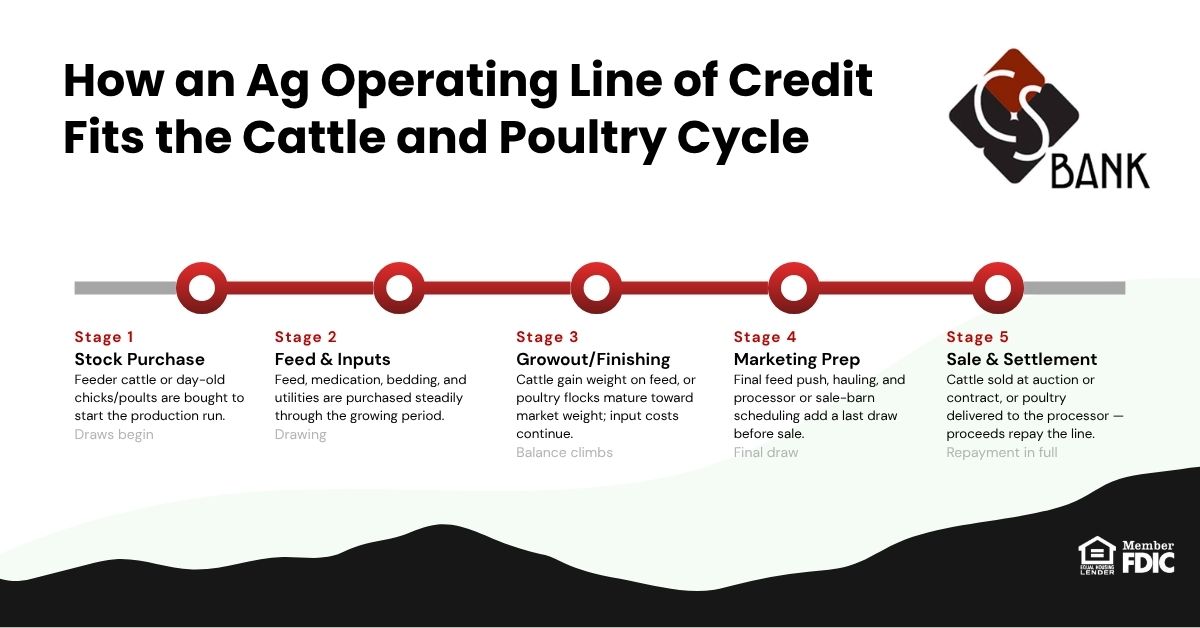
Interest typically accrues only on the amount you have borrowed, not the entire approved credit limit.
For example, having an approved ag operating line does not mean you have to borrow the full amount at once. You can draw what you need for current operating costs, reduce the balance when income arrives, and use the line again when another expense comes up.
Ag operating lines are also commonly reviewed or renewed on a regular basis, often annually.
What Can an Ag Operating Line of Credit Cover?
The purpose of an ag operating line of credit is to help pay the recurring costs that keep the operation moving.
For a cattle producer, those costs can include feed, veterinary care, fuel, labor, and certain breeding-related expenses. The bills may continue for months before calves or other cattle are ready to sell.
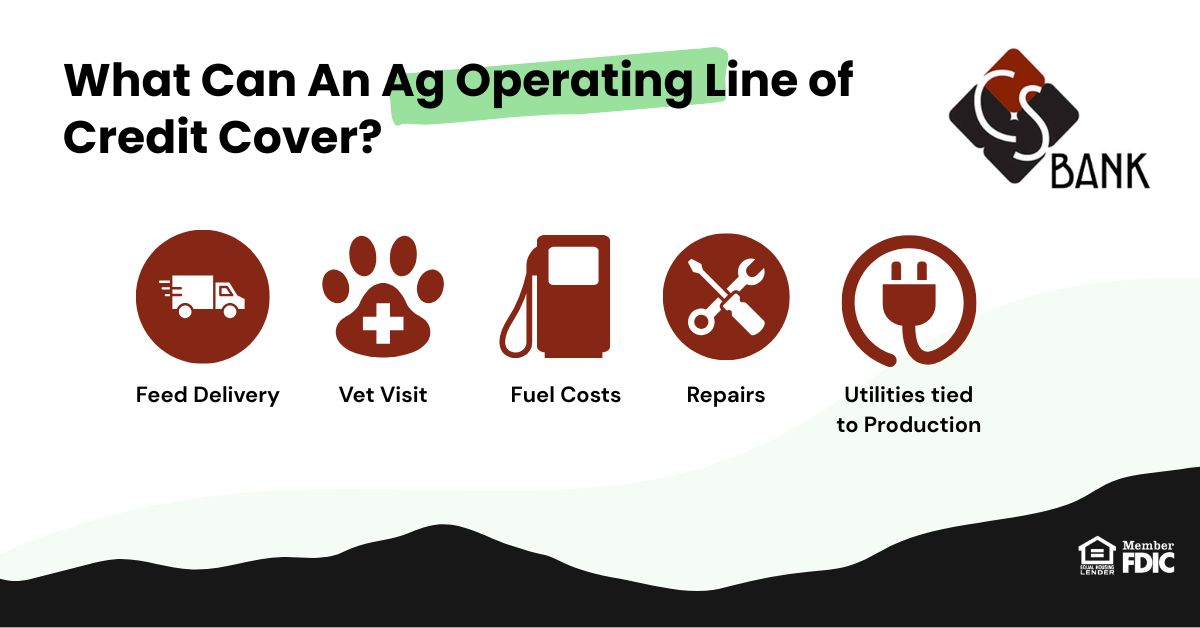
Poultry producers work on a different cycle. Costs such as chicks, feed, labor, and routine housing upkeep can come due before revenue associated with the flock is received.
Major long-term purchases are different. Buying land or financing a large piece of equipment generally calls for a term loan, agricultural real estate loan, or another type of financing structured around the useful life of the asset.
The distinction often comes down to the type of expense. An ag operating line of credit is designed around working-capital needs that come back as part of running the farm.
How an Ag Operating Line of Credit Fits the Farm Cycle
Take a cattle operation raising calves for sale.
Costs continue while the animals grow, even though the income tied to those cattle may still be months away. The producer can draw from the operating line during that period instead of funding every expense entirely from cash on hand. When the cattle are sold, proceeds can be used to reduce or pay off the outstanding balance.
For a poultry producer, borrowing can follow the flock cycle. Funds can cover qualifying expenses as they arise, with the balance paid down after payment is received from an integrator or after the flock is sold.
Livestock and poultry income does not necessarily arrive on a predictable monthly schedule, which makes timing especially important. An ag operating line of credit gives producers a way to manage working-capital needs without assuming that farm revenue will show up at the same time every month.
Producers should ask how draws and repayments are handled when comparing their options.
Our Agricultural Lending Options
At CS Bank, our agricultural lending options include revolving lines of credit for operating expenses as well as financing designed for livestock and poultry operations.
We know those operations do not all have the same financial cycle. A cattle producer adding breeding stock faces different costs and timing than a poultry grower working through multiple flock cycles. The amount of financing needed, expected repayment, and available collateral all help shape the financing conversation.
Our livestock lending options and poultry lending options are designed with those kinds of needs in mind. CS Bank’s Ag Lenders look at how financing fits the operation itself rather than approaching every agricultural customer with the same structure.
We also work directly with the Farm Service Agency on FSA-guaranteed operating loans.
An FSA guarantee provides another path for producers who do not meet all the requirements for conventional agricultural financing. Our team works with FSA on the paperwork involved in these loans. Eligibility, approval, and final terms remain subject to applicable FSA guidelines and the individual application.
Our Preferred Lender Program status also helps streamline the FSA guarantee process.
A conventional operating line may make sense for one producer, while an FSA-guaranteed loan could be a better option for another. Our FSA Loans page provides more information about how these programs work and the types of financing available.
If your plans extend beyond operating expenses, our “Finance Your Family Farm’s Future with CS Bank” article takes a broader look at financing farm expansion, including larger investments in land and equipment.
What Will an Ag Lender Want to Know?
When you talk with an ag lender about an operating line, expect the conversation to focus on how the farm generates revenue and how borrowed funds will be repaid.
Credit history is part of the review. Lenders also typically consider the operation’s revenue history, expected cash flow, business plan, existing debt, and available collateral.
For an ag operating line of credit, the timing of the operation is especially important. A lender needs a clear picture of when major expenses occur and how long the operation typically carries those costs before revenue comes in. That helps establish how much working capital is appropriate and how repayment could fit the business. Starting that conversation before cash becomes tight gives both the producer and lender more room to consider the available options.
Our agricultural lenders live and work in the communities we serve, and many have farming experience themselves. That firsthand understanding helps them talk through financing in the context of how a farm operation actually runs.
You can learn more about our approach and available financing on our Ag Lending page.
Finding the Right Fit for Your Operation
An ag operating line of credit can be a useful tool for managing ongoing expenses between cattle sales or poultry payments. The key is making sure the financing structure fits the way your operation runs.
Talk to a CS Bank Ag Lender about your working-capital needs and the financing options available for your operation.