

not featured
2026-08-21
8/21/2026
Personal Banking
published

Your Banking Ecosystem: Checking, Savings & Beyond
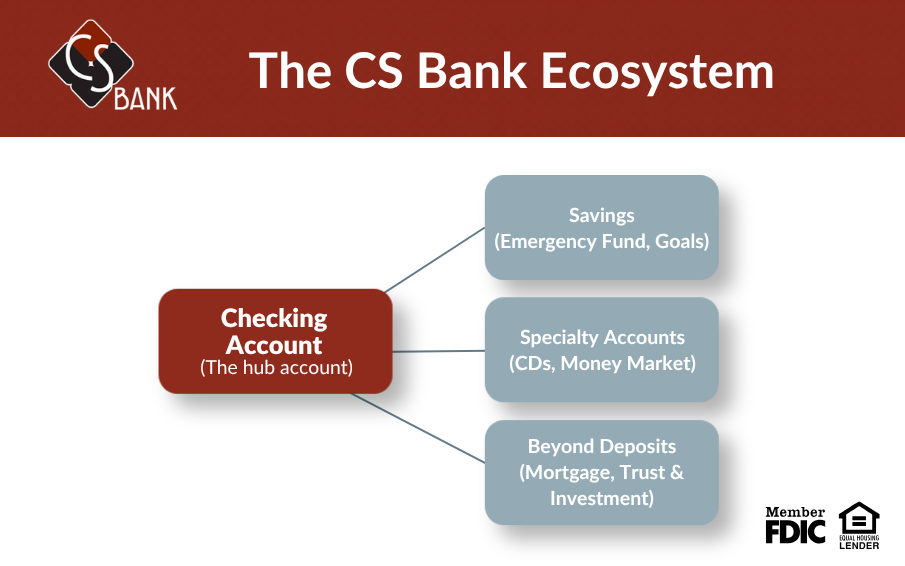
Picture this: your paycheck lands on Friday. By Monday, rent is paid, the fridge is stocked, and whatever is left just sits there until the next paycheck arrives. If that sounds familiar, you are not managing your money wrong, you are just asking one account to do a job that really calls for several. Most people think of banking as a single account, the one where paychecks land and bills go out. We prefer a different approach: think of your accounts as a financial ecosystem, where each one has a specific job to do.
No matter how many accounts you open with us, your money is protected. Each customer receives up to $250,000 in coverage from the Federal Deposit Insurance Corporation (FDIC) across all their accounts, in the unlikely event of a bank failure. Married couples receive up to $500,000 in coverage for joint accounts, on top of $250,000 for each individual account.
So how many accounts should you actually have? As many as it takes to manage your funds and make the most of what you earn. The median American household holds $8,000 across its checking, savings, and money market accounts combined, according to the Federal Reserve's 2022 Survey of Consumer Finances, a figure that has climbed steadily as more households spread their funds across multiple account types. Consider this your guide to building an account setup that actually works, wherever you bank in Northwest Arkansas or Southwest Missouri.
Your Checking Account — The Hub of Your Financial Life
Your first checking account usually opens the moment you start earning a paycheck, and it quickly becomes the account that does the most work: deposits land there, bills go out from there, and your everyday spending flows through it. When you are choosing one, look for no hidden fees and free digital tools like online and mobile banking. Card controls are worth a closer look too. Set spending alerts, restrict where your card can be used, or lock it instantly from your phone the moment it goes missing.
Your Savings Account — The Buffer Between You and Life
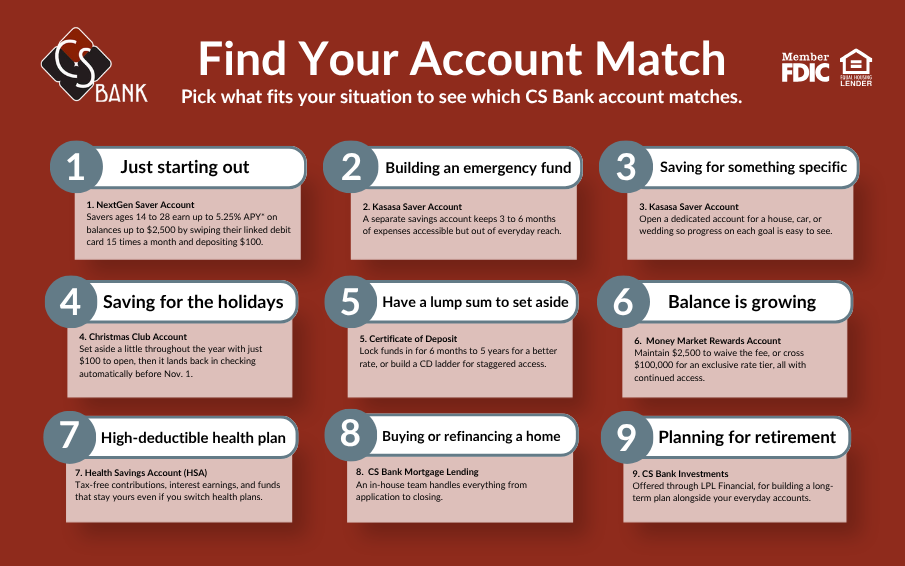
Life throws curveballs: a car repair, a slow month at work, an unexpected medical bill. An emergency fund covering three to six months of essential expenses, rent or mortgage, utilities, groceries, is what keeps a curveball from turning into a crisis. Keeping that money in a separate savings account, rather than mixed in with checking, makes it far less tempting to spend on something else. Automate it: set up a transfer with every paycheck, every week, or once a month, and let the habit build itself.
One savings account rarely does it all. Set up a savings plan with a separate account for each goal: one for your emergency fund, another for a house down payment, a new vehicle, a vacation, an education fund, or a wedding. Splitting goals into separate buckets makes progress on each one easier to see, which is exactly why so many of our customers end up with more than one account.
Specialty Accounts — When One Savings Account Isn't Enough
Beyond checking and everyday savings, specialty accounts unlock benefits built for a specific purpose, whether that's a holiday budget, a rainy-day cushion, or a medical expense fund. Here's what's available to our customers in Northwest Arkansas and Southwest Missouri:
Christmas Club Accounts
Holiday spending sneaks up on everyone. A Christmas Club Account lets you set aside a little at a time all year, so December does not blow up your budget. Open one with just a $100 minimum deposit, earn interest on deposits up to $5,000, and pay no monthly fees. Your savings land back in checking automatically before Nov. 1, right when you need them.
NextGen Saver
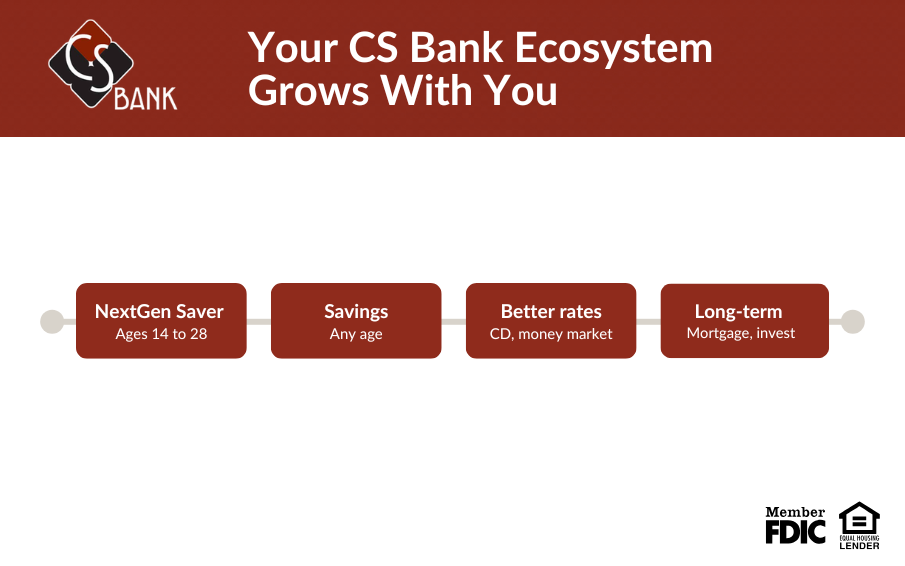
The best time to build a savings habit is before life gets complicated. NextGen Saver, built for customers ages 14 to 28, rewards you for doing exactly that. Swipe your linked CS Bank debit card 15 times a month and deposit at least $100 into the account, and you'll earn up to 5.25% APY on balances up to $2,500 (balances above that earn a lower rate on the extra). There is no monthly fee with eStatements, and meeting the qualifications within your first 90 days earns you a $25 bonus just for starting.
Certificates of Deposit (CDs)
A Certificate of Deposit trades access for a better rate: lock your money away for a set term, from six months to five years, and the longer you commit, the more you earn. Not ready to lock it all in? Split your funds across CDs with staggered terms instead, known as a CD ladder. It's a popular move for part of an emergency fund, since a CD is always coming due soon, and for goals with a specific date attached, since you can time the ladder so everything matures together. Our free CD ladder calculator does the math for you.
Money Market Accounts
A money market account is the middle ground: better rates than standard savings, without giving up access to your money. We offer two, both with tiered rates that reward bigger balances.
Money Market Rewards: Maintain a $2,500 monthly balance and the monthly service fee disappears.
Century Money Market Rewards: Cross $100,000 and unlock an exclusive rate tier.
Health Savings Accounts (HSAs)
On a high-deductible health plan? A Health Savings Account (HSA) might be one of the most underused accounts you're eligible for. Contributions are tax-free up to an annual limit, the balance earns interest, and the funds cover qualified medical expenses whenever you need them. Unlike a flexible spending account, an HSA is yours to keep for good, even if you switch health plans down the road.
How to Structure Your Banking Ecosystem
A simple starting point looks like this: one checking account for everyday spending, one savings account for your emergency fund, and one goal-oriented account for whatever you're working toward next. Keep them all with us, and you can manage the entire lineup from one place through our online portal and mobile banking app, checking balances, moving money between accounts, and paying bills in a few taps.
Beyond Deposit Accounts
A true banking ecosystem often stretches past checking and savings. As your financial picture grows, a mortgage or an investment account can become just as central to your plan.
If a home purchase or refinance is on the horizon, CS Bank's mortgage lending team works in-house from application to closing. Thinking further down the road? CS Bank Investments, offered through LPL Financial, can help you build a plan for retirement, education, or other long-term goals alongside your everyday accounts.
Why Local Banking Makes This Easier
Building the right mix of accounts is easier when you're working with people who know your situation, not a call center reading from a script. Our local bankers can sit down with you, walk through your goals, and help you decide which accounts actually make sense, whether that means opening a second savings account, setting up a CD ladder, or moving into a money market account as your balance grows.
As your life changes, whether you're starting a family, buying a home, or planning for retirement, your banking ecosystem should change with it. Stop by any of our Northwest Arkansas or Southwest Missouri locations to talk through your current account setup, or to adjust it as your needs evolve.
Access the Best Personal Banking in Northwest Arkansas and Southwest Missouri
Not sure your current setup is pulling its weight? Contact your local CS Bank in Harrison, Berryville, Eureka Springs, Huntsville, AR, or Cassville, MO, and we'll help you build an ecosystem that actually works for you. Ready to start now? Open an account online today.