


not featured
2026-09-21
9/21/2026
Personal Banking
published

The Untold Truth Behind 'Finfluencers'
Spend enough time on TikTok, Instagram, or YouTube and financial advice will eventually find its way into your feed.
One person is explaining how to build credit. Another is sharing a savings strategy. Someone else is recommending a money habit you should be using right now.
These creators are often called finfluencers, short for financial influencers, and there is a reason they have become so popular. Money can be confusing, and a good creator can make a complicated topic feel easier to understand in less than a minute.
That accessibility can be helpful, especially for someone who might otherwise avoid financial topics. But important details can be cut out when a complicated decision has to fit into a video or post.
Before you change the way you save, borrow, spend, or invest based on something you saw online, it helps to understand who is giving the advice, what may be behind it, and whether it makes sense for your situation.
What Is a Finfluencer?
A finfluencer is someone who uses social media to share financial information, opinions, tips, or recommendations that can influence how other people handle their money.
Some have professional experience or financial credentials. Others are sharing lessons from their own lives or building an audience around saving, credit, debt, and investing.
The content they share can also be a business. Creators may earn money from sponsorships, affiliate relationships, paid promotions, courses, or subscriptions. That doesn’t automatically make their recommendations unreliable, but it is useful context.
Before acting, know whether the creator is sharing personal experience, explaining a financial concept, promoting a product, or being paid in some way for the content.
Why This Content Works So Well for Gen Z
Finfluencers have succeeded in part because they speak a language traditional financial education has not always spoken particularly well.
The videos are short and the examples feel current and relatable. Just as important, the person explaining the topic may sound more like a peer than someone giving a formal financial presentation.
For a generation that has grown up learning everything from cooking techniques to car repair on the internet, learning about money in the same way feels logical and natural.
When things go well, a video about emergency savings might prompt someone to open a savings account. A post about credit scores could lead someone to check a credit report for the first time. Someone who has never thought much about investing may hear an unfamiliar term and decide to learn more.
Problems arise when a useful introduction starts to sound like an answer that should work for everyone. A strategy that worked for one creator may make little sense for someone with different income, expenses, debt, goals, or responsibilities.
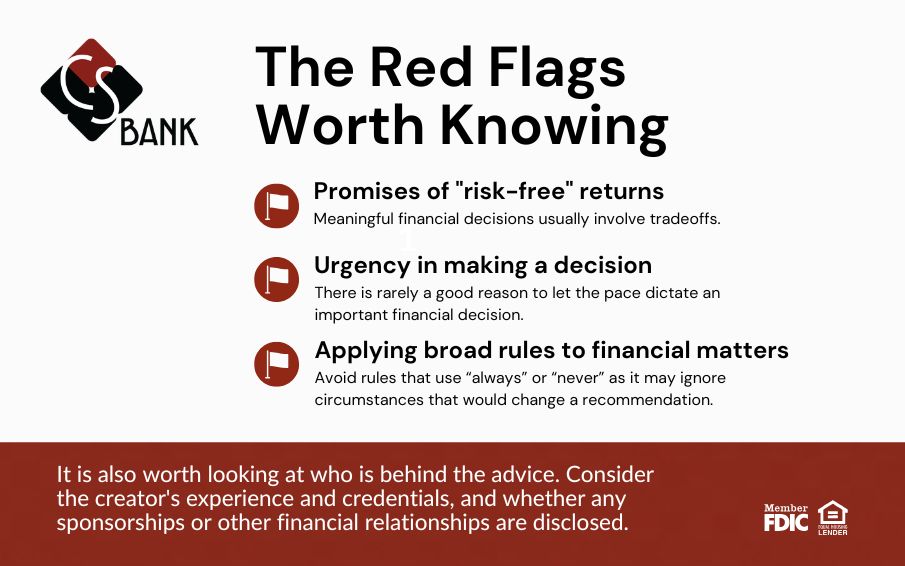
The Red Flags Worth Knowing
Bad financial advice doesn’t always sound outrageous. Often, it sounds confident.
Promises of "risk-free" returns or "easy money" deserve a closer look. Meaningful financial decisions usually involve tradeoffs, and content that focuses only on potential benefits may leave out risks or limitations that matter.
Urgency is another reason to slow down. A post might suggest an opportunity is disappearing or everyone else is already getting in. Social media rewards speed and attention, but there is rarely a good reason to let that pace dictate an important financial decision, especially when the creator may benefit if you click, buy, sign up, or invest.
Broad rules can also mislead. Financial content favors clean, memorable advice because it fits neatly into a post or video. Real life is usually messier, and words such as "always" or "never" may ignore circumstances that would change the recommendation.
It is also worth looking at who is behind the advice. Consider the creator's experience and credentials, and whether any sponsorships or other financial relationships are disclosed. If the advice could have a meaningful impact on your finances, it is a good idea to confirm the information through another credible source. The Arkansas Securities Department published an investor advisory on financial influencers that offers additional guidance on what to check before acting on a tip.
You don’t need to investigate every budgeting tip. A suggestion about packing lunch twice a week for instance deserves less scrutiny than a decision involving significant savings, borrowing, or investing.
What Finfluencers Can't Offer
Even a knowledgeable creator has one major limitation: they don’t know your finances.
A video can’t see your paycheck alongside your rent, student loans, credit card balance, emergency savings, upcoming expenses, or longer-term goals. Those circumstances can materially affect what makes sense.
A creator telling viewers to aggressively pay down a certain type of debt, for example, can’t see whether you have enough cash for an unexpected expense next month. Someone discussing an investment doesn’t know when you may need the money or how much risk you are comfortable taking.
Credentials and professional experience also vary widely. A large following and polished videos alone don’t tell you what experience someone has or whether the advice is appropriate for your situation.
There is also a practical difference in accountability. A social media creator is not accountable to you in the same way someone you work with directly can be. They are unlikely to know the circumstances behind your decision or be available to discuss what might change the answer. If the advice turns out to be a poor fit, the person who posted it may never know you acted on it.
A Better Way to Use Financial Content Online
There is worthwhile financial content online, especially when it makes an unfamiliar topic easier to approach. The key is treating that content as a starting point for learning, rather than a final answer for an important decision.
A video can introduce a savings method, explain a term, or prompt you to reconsider a money habit. For something that could meaningfully affect your finances, spend more time checking the information before acting.
This matters most when you are considering a major borrowing decision, moving a significant amount of savings, making an investment, or committing to something that could affect your finances for years.
Social media can also motivate someone to start with a basic financial habit. If a video gets you thinking about saving, building that habit and understanding how your accounts work can be more useful than jumping from one viral strategy to another.

Before You Act on Something You Saw Online, Do This
A finfluencer may be what gets you interested in a financial topic in the first place, and that curiosity can be a good starting point for learning more.
The more important the decision, the more useful it is to check what you heard against a source that can consider your specific circumstances.
For younger savers who want a place to start, CS Bank's NextGen Saver account is designed to help those ages 14–28 build regular savings habits.
Remember, if a tip raises questions about your banking, savings, investing, or borrowing, it makes sense to consider how it fits into your broader financial picture. Have a question about something you saw online? Talk to a CS Bank banker for a real, accountable second opinion.